Physical Address
304 North Cardinal St.
Dorchester Center, MA 02124
Physical Address
304 North Cardinal St.
Dorchester Center, MA 02124

Understanding business research methods is crucial, whether you’re launching a new startup or steering an established company. It’s all about making informed decisions based on real data, which often means the difference between success and failure. By learning how to approach research thoughtfully, you can identify market trends, understand customer needs, and drive your business forward with confidence. 
Think of it this way: every significant business decision relies on some form of research. Whether you’re analyzing customer feedback or examining competitor performance, the insights you gather shape your path and inform your next moves. Knowing how to conduct this research isn’t just beneficial; it’s essential.
In this guide, we’ll walk through various business research methods and share real-world examples that demonstrate their value. You’ll see how they apply directly to everyday business scenarios, making the information not just theoretical but practical and actionable.
By the end, you’ll have a clearer picture of how to harness research to propel your business decisions and create a more adaptive strategy. It’s about equipping yourself with knowledge that can lead to better outcomes and a more informed approach in an increasingly complex market.
Business research methods encompass a systematic approach to gathering, analyzing, and interpreting information relevant to business decisions. Below are the core concepts that make up this discipline.
| Step | Description |
|---|---|
| Problem Identification | Clearly define the issue you want to address, ensuring it is specific and actionable. |
| Literature Review | Examine existing research and data to inform your study and provide context for your findings. |
| Research Design | Choose between qualitative and quantitative methods, selecting the tools and techniques for data collection. |
| Data Collection | Gather data using the methods identified in your research design. |
| Data Analysis | Analyze the collected data to derive meaningful insights that address the business problem. |
| Reporting | Communicate findings through reports, presentations, or dashboards, emphasizing actionable insights. |
Business research can take various forms, and here are a few practical applications:
The insights gleaned from these research efforts can lead to informed decisions, taking businesses further in their operational or strategic goals.
For those interested in exploring analytics, check out this resource on business analytics for real-world examples that drive decision-making.
A company considering launching a new smartphone conducts market research to assess consumer preferences, competitive offerings, and pricing strategies through surveys and focus groups.
Why this matters: Highlighting the importance of understanding customer needs can drive a successful product launch, minimizing the risk of market failure.
An organization implements regular employee satisfaction surveys to gauge workplace morale and identify areas for improvement in management practices and workplace environment.
Why this matters: Providing insights into employee sentiment helps enhance retention strategies and fosters a more engaged workforce.
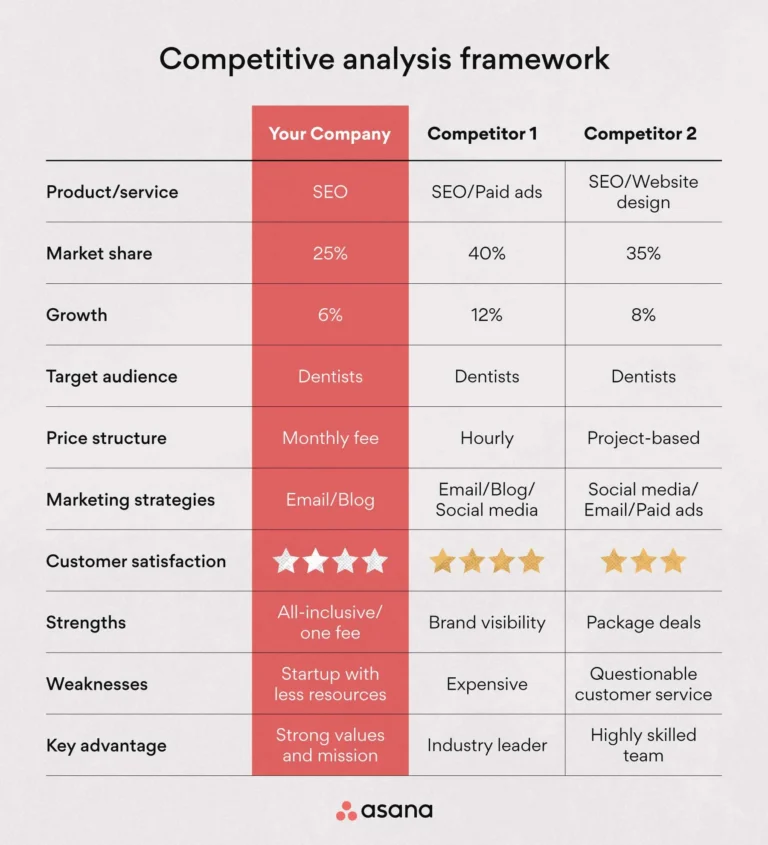
A retail chain evaluates its performance against competitors by analyzing sales data, pricing structures, and customer service feedback to identify gaps and opportunities.
Why this matters: Stating the significance of competitive insights allows businesses to make informed adjustments to their operational strategies.
A clothing brand uses demographic and psychographic research to segment its audience, tailoring marketing campaigns to different consumer groups such as millennials and eco-conscious shoppers.
Why this matters: Asking the right questions about consumer profiles ensures marketing messages resonate and increase conversion rates.
A software company employs historical sales data combined with market trends to predict future sales, aiding in inventory management and production planning.
Why this matters: By keeping accurate forecasts, businesses can optimize their resources and avoid overproduction or stockouts.
A brand leverages social media analytics tools to assess engagement rates, audience demographics, and campaign effectiveness, guiding future marketing efforts.
Why this matters: Highlighting analytics provides actionable insights that allow companies to refine their social media strategies and improve ROI.
A restaurant chain establishes a feedback loop where customers can share their dining experiences via digital surveys, leading to improvements in service and menu offerings.
Why this matters: Providing a platform for customer input fosters a culture of continuous improvement, enhancing customer satisfaction and loyalty.
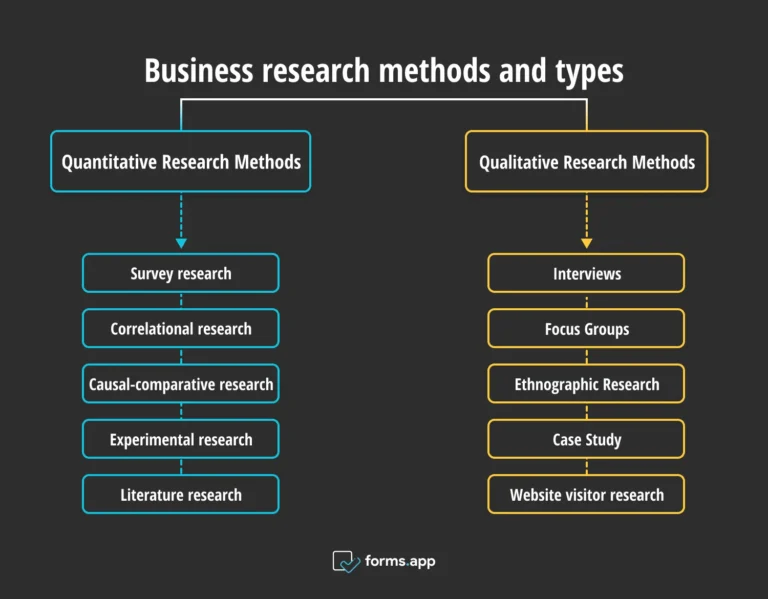
Business research methods generally fall into two categories: qualitative and quantitative. Qualitative methods focus on exploring concepts and understanding underlying motivations through interviews or focus groups. Quantitative methods, on the other hand, involve numerical data collection and statistical analysis, often through surveys or experiments.
Sure! A company might use surveys to gather customer feedback on a new product, which is a quantitative approach. Conversely, a focus group discussion can help understand customer perceptions about a brand, illustrating a qualitative technique. Both methods offer valuable insights for decision-making.
Organizations usually base their choice on research objectives, budget, and time constraints. If the aim is to gather numerical data quickly, they may opt for a survey. For deeper insights into consumer behavior, they might choose qualitative methods, even if they take more time and resources.
Common challenges include collecting unbiased data, ensuring sufficient sample sizes, and interpreting findings correctly. Moreover, the reliance on self-reported data can introduce inaccuracies, making it crucial to design research carefully to mitigate these issues.
Understanding business research methods gives you the tools to make informed decisions about your ventures, ensuring that you’re not just guessing but basing your actions on solid data. Whether you’re conducting surveys, analyzing existing trends, or diving into case studies, the real-world applications are plentiful and can steer your business towards success. Embracing these methods can feel a bit overwhelming at first, but with time and practice, it becomes second nature. So, next time you’re faced with a big choice, remember that a little research can go a long way. Check out how business analytics can further enhance your decision-making—your future self will thank you!